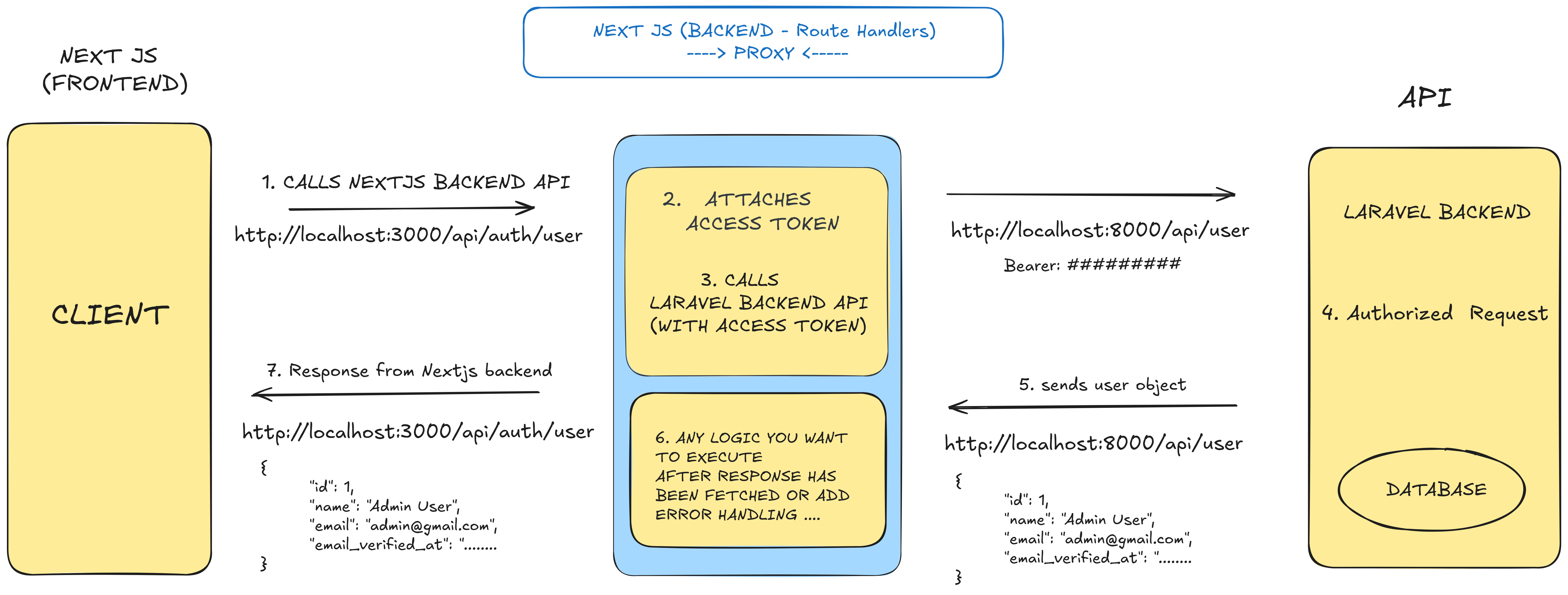
Building a modern web application often requires a clean separation between frontend and backend while still maintaining smooth communication between them. In this architecture, Next.js acts not only as the frontend but also as a lightweight backend layer using route handlers. Instead of directly calling the Laravel API, the client communicates with Next.js, which acts as a proxy. This approach improves security, simplifies token handling, and centralizes API logic.
When a user interacts with the application, the Next.js frontend sends a request to its own backend API routes. These routes then attach authentication details, such as access tokens, before forwarding the request to the Laravel backend. This proxy pattern ensures that sensitive data like tokens are never exposed directly to the client, making the application more secure and easier to manage. It also allows developers to implement additional logic such as validation, logging, or transformation before reaching the backend.
Laravel serves as the core backend API, handling authentication, business logic, and database operations. Once the request reaches Laravel, it validates the token, processes the request, and interacts with the MySQL database to fetch or store data. After processing, Laravel sends a structured response (such as a user object), which travels back through the Next.js layer before reaching the client. This layered flow ensures scalability and maintainability in larger applications.
Tailwind CSS complements this stack by enabling rapid UI development with utility-first styling, making it easy to build responsive and consistent interfaces. Altogether, this stack provides a powerful combination: Next.js for frontend and API proxying, Laravel for backend logic, MySQL for reliable data storage, and Tailwind for modern UI design. This architecture is especially useful for applications that require strong authentication, clean separation of concerns, and high performance.
Tags
More Articles
How to Make Money as a Student in Nepal: Practical Ways to Start Earning
Being a student in Nepal often comes with financial challenges, from managing daily expenses to supporting education costs. However, with the growth of the internet and digital opp...
Deploying a Laravel + Next.js App on VPS Using HestiaCP: A Step-by-Step Guide
Deploying a full-stack application that uses Laravel for the backend and Next.js for the frontend on a VPS may seem difficult at first, but with HestiaCP, the process becomes much...
The Rise of Artificial Intelligence in Nepal: Current Trends and Impact
Artificial Intelligence (AI) is rapidly transforming Nepal’s digital landscape, moving from a niche concept to a widely adopted technology across multiple sectors. In recent years,...